Buying a fiber laser cutting machine is a major investment for any metal fabrication business. With different laser powers, working areas, laser sources, cutting heads, control systems, and machine configurations available on the market, choosing the right machine can be challenging.
A machine with higher power is not necessarily the best choice for every business. The right fiber laser cutter should match your materials, cutting thickness, production volume, required cutting quality, workshop space, and budget.
This fiber laser cutting machine buying guide explains the key factors you should consider before purchasing a CNC fiber laser cutter and introduces the important specifications that can affect your machine’s performance and long-term operating costs.
What Is a Fiber Laser Cutting Machine?
A fiber laser cutting machine is a CNC machine that uses a high-power fiber laser to cut metal materials with high precision.
Compared with traditional mechanical cutting methods, fiber laser technology offers several advantages, including high cutting precision, relatively fast processing speeds, narrow kerfs, and the ability to process a wide range of metal materials.
Fiber laser cutting machines are commonly used for:
- Carbon steel
- Stainless steel
- Aluminum
- Brass
- Copper
- Galvanized steel
- Other metal sheets and plates
The machine typically consists of several key systems, including the laser source, cutting head, CNC control system, motion system, machine bed, servo motors, cooling system, and assist-gas system.
Understanding these components is essential when comparing different machines.
1. Determine What Materials You Need to Cut
The first question to ask before buying a fiber laser cutting machine is:
What materials will you cut most frequently?
Different metals have different thermal and reflective properties, so your material requirements directly affect the recommended machine configuration.
Carbon Steel
Carbon steel is one of the most common materials processed by fiber laser cutters.
Typical applications include:
- Machinery components
- Structural parts
- Brackets
- Frames
- Agricultural machinery
- General metal fabrication
Stainless Steel
Stainless steel is widely used in:
- Kitchen equipment
- Food-processing equipment
- Decorative metal products
- Electrical cabinets
- Architectural components
Aluminum
Aluminum is lightweight and highly reflective, which means the laser source and cutting parameters need to be selected appropriately.
Brass and Copper
Copper and brass have higher reflectivity than many other metals. If these materials are a major part of your production, make sure the machine supplier understands your material requirements before recommending the laser configuration.
Tip: Do not simply tell a machine supplier that you need to cut “metal.” Provide the exact materials you use most frequently.
2. Determine the Maximum Cutting Thickness
After identifying your materials, determine the maximum thickness you need to cut.
This is one of the most important factors when selecting laser power.
For example, a manufacturer mainly processing thin sheet metal may not need the same laser power as a company regularly cutting thick carbon steel plates.
When discussing your requirements with a supplier, provide:
- Material type
- Minimum thickness
- Typical thickness
- Maximum thickness
- Percentage of production at each thickness
This information allows the manufacturer to recommend a more appropriate laser configuration.
Maximum Thickness vs. Recommended Thickness
There is an important difference between the maximum thickness a laser can technically cut and the thickness that the machine can cut efficiently and consistently for production.
A machine may be capable of cutting a particular thickness under specific conditions, but that does not necessarily mean it is the most economical thickness for continuous production.
When comparing machines, ask suppliers for practical cutting samples rather than relying only on maximum thickness claims.
3. Choose the Right Laser Power
Laser power is one of the most frequently discussed specifications when buying a fiber laser cutting machine.
Common configurations include:
- 1.5 kW
- 2 kW
- 3 kW
- 4 kW
- 6 kW
- 12 kW
- Higher-power configurations for specific industrial applications
However, more power is not always better.
Higher laser power can provide greater cutting capability and potentially higher productivity for suitable materials and thicknesses, but it also increases equipment investment and may require different auxiliary systems.
Your decision should be based on:
Material + Thickness + Production Volume + Required Speed + Budget
For example, a small fabrication shop mainly cutting thin stainless steel may benefit more from a properly configured 3 kW machine than from purchasing a much higher-power system that it rarely needs.
4. Choose the Right Working Area
The working area determines the size of the sheet that can be processed.
One of the most common formats is:
3015 = approximately 3000 × 1500 mm
The 3015 format is widely used because it provides a practical balance between sheet capacity and machine footprint.
A 3015 fiber laser cutting machine can be suitable for businesses processing standard sheet-metal formats and a wide range of custom parts.
When choosing the working area, consider:
- Your standard sheet size
- Material storage
- Loading method
- Workshop dimensions
- Finished-part handling
- Future production requirements
If most of your materials fit within a 3000 × 1500 mm working area, a 3015 machine can be a practical choice.
For customers who need larger sheet sizes, larger-format machines may be more appropriate.
5. Single Table or Exchange Table?
Another important decision is the machine table configuration.
There are two common options:
| Feature | Single Table | Exchange Table |
|---|---|---|
| Initial Investment | Lower | Higher |
| Structure | Simpler | More Complex |
| Loading/Unloading | Manual | Faster workflow |
| Floor Space | More Compact | Generally Larger |
| Production Volume | Low to Medium | Medium to High |
| Maintenance | Relatively Simple | More Components |
| Best For | General Fabrication | High-Volume Production |
A single-table fiber laser cutting machine can be a good option for small and medium-sized fabrication businesses.
An exchange-table machine becomes more attractive when the machine operates continuously and loading/unloading time represents a significant portion of the production cycle.
For a detailed comparison, see our guide to Single-Table vs. Exchange-Table Fiber Laser Cutting Machines.
6. Consider a Full-Enclosed Machine Design
A full-enclosed fiber laser cutting machine provides an enclosed cutting area around the processing zone.
This design can provide several benefits:
- Better separation between the operator and cutting area
- Improved containment of cutting fumes
- More integrated machine structure
- Professional workshop appearance
- Compatibility with appropriate fume extraction systems
For businesses that value an integrated and enclosed machine layout, a full-enclosed configuration can be an attractive choice.
7. Evaluate the Laser Source
The laser source is one of the most important components of a fiber laser cutting machine.
When comparing machines, do not look only at the brand name.
Also consider:
- Rated laser power
- Beam quality
- Expected service life
- Energy efficiency
- Warranty
- Local technical support
- Availability of replacement components
A reputable laser source combined with a properly designed optical and motion system can contribute to stable long-term performance.
The best choice depends on your budget, application, and local service requirements.
8. Check the Laser Cutting Head
The cutting head focuses the laser beam onto the material and plays an important role in the cutting process.
When evaluating a machine, consider:
- Autofocus capability
- Focus adjustment
- Nozzle design
- Protective window
- Height sensing
- Availability of consumables
- Serviceability
A good cutting head should work together with the laser source, CNC control system, and cutting parameters as an integrated system.
9. Pay Attention to the CNC Control System
The CNC control system is the interface between the operator and the machine.
A modern laser cutting control system can manage functions such as:
- Cutting path control
- Piercing parameters
- Autofocus
- Height sensing
- Cutting parameter management
- Machine movement
- Error monitoring
When comparing different machines, consider not only the software functions but also:
- Ease of operation
- Stability
- User interface
- Local technical support
- Software updates
- Compatibility with your production workflow
A powerful machine with complicated or poorly supported software can create unnecessary operating difficulties.
10. Check the Machine Bed and Motion System
The machine bed is often overlooked by first-time buyers.
However, the mechanical structure has a direct influence on long-term stability and cutting accuracy.
A well-designed machine bed should provide:
- Good structural rigidity
- Resistance to deformation
- Stable operation
- Reliable support for the motion system
You should also evaluate:
- Linear guide rails
- Rack and pinion
- Servo motors
- Reducers
- Transmission system
Do not compare laser machines based solely on the laser source. The entire mechanical system matters.
11. Consider the Cooling System
Fiber laser sources and other optical components generate heat during operation.
An industrial water chiller is commonly used to maintain the appropriate operating temperature.
When comparing machines, check:
- Chiller capacity
- Temperature control
- Alarm functions
- Cooling stability
- Local service availability
A stable cooling system is important for maintaining reliable machine operation.
12. Understand Assist Gas Requirements
Assist gas plays an important role in fiber laser cutting.
Common gases include:
- Oxygen
- Nitrogen
- Compressed air
The appropriate gas depends on the material, thickness, required edge quality, and production requirements.
For example, nitrogen is commonly used when a cleaner, oxidation-free edge is required on stainless steel and some other applications.
Oxygen can be useful for certain carbon-steel cutting applications.
Compressed air may provide a cost-effective option for some applications where the required cutting quality and material thickness allow it.
Therefore, assist-gas consumption should be included when calculating the operating cost of your laser cutting machine.
13. Calculate the Total Cost of Ownership
The purchase price is only one part of the cost of owning a fiber laser cutting machine.
Before purchasing, consider:
Machine price + Installation + Electricity + Assist gas + Consumables + Maintenance + Spare parts + Labor
For example, consumables may include:
- Nozzles
- Protective windows
- Ceramic rings
- Cutting head components
- Other replacement parts
A machine with a lower purchase price may not necessarily have the lowest total cost of ownership.
Instead, compare the machine based on its expected production efficiency and operating cost over several years.
14. Consider After-Sales Service
After-sales support is particularly important when purchasing industrial equipment internationally.
Before placing an order, ask:
- What warranty is provided?
- What components are covered?
- Is remote technical support available?
- How quickly can spare parts be supplied?
- Is installation support included?
- Is operator training available?
- Does the supplier have experience exporting to your country?
A reliable supplier should be able to provide technical documentation, installation guidance, troubleshooting support, and replacement components.
How to Choose the Right Fiber Laser Cutting Machine for Your Business
A simple decision process can help narrow down your options.
Step 1: Define Your Materials
Write down the metals you process most frequently.
Step 2: Define Your Thickness
Identify your typical and maximum cutting thickness.
Step 3: Define Your Production Volume
Estimate how many sheets or parts you need to process per day or month.
Step 4: Select the Working Area
Choose a machine format that fits your normal sheet sizes.
Step 5: Select Laser Power
Choose laser power based on your actual material and thickness requirements.
Step 6: Select the Table Configuration
Determine whether a single table is sufficient or whether you need an exchange table.
Step 7: Compare Machine Components
Evaluate the laser source, cutting head, CNC system, servo motors, guides, transmission system, and chiller.
Step 8: Compare Total Cost of Ownership
Look beyond the initial machine price.
Step 9: Evaluate the Supplier
Check manufacturing experience, export experience, technical support, warranty, and spare-parts availability.
Is a 3015 Fiber Laser Cutting Machine Right for You?
For many metal fabrication businesses, a 3015 fiber laser cutting machine offers a practical combination of working area, machine size, flexibility, and investment cost.
If your typical sheet size is around 3000 × 1500 mm and you do not require a fully automated loading and unloading system, a 3015 single-table machine may be a particularly practical solution.
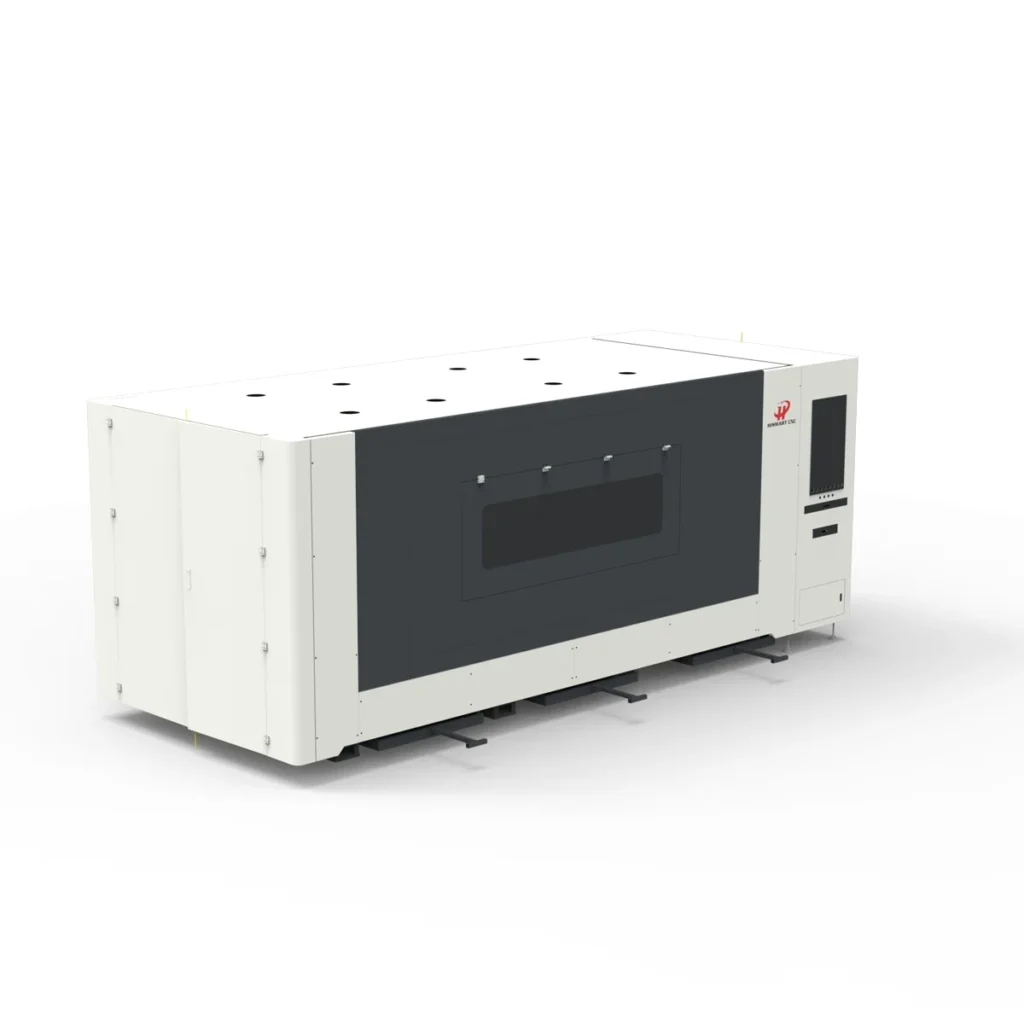
This is where the Hismart CNC HS3015i can be a suitable option.
The HS3015i combines a 3015 working format with a full-enclosed single-table design, making it suitable for a wide range of general sheet-metal cutting applications.
The exact laser power and component configuration can be selected according to your material, thickness, production volume, and budget.
Why Choose Hismart CNC HS3015i?
The HS3015i is designed for customers who need a practical CNC fiber laser cutting solution without necessarily requiring a large automated exchange-table production line.
Key advantages include:
- 3000 × 1500 mm working area
- Full-enclosed design
- Single-table configuration
- Fiber laser technology
- Flexible laser-power options
- Suitable for various sheet-metal applications
- Customizable machine configuration
- International export experience
Hismart CNC can help customers evaluate their application requirements and select an appropriate configuration based on the materials and thicknesses they need to process.
Frequently Asked Questions
What is the best fiber laser cutting machine for a small business?
There is no single machine that is best for every small business.
For businesses with low-to-medium production volumes, a compact single-table fiber laser cutter can provide a good balance between investment, productivity, and workshop space.
Is a 3015 laser cutting machine good for sheet metal?
Yes. A 3015 machine provides approximately a 3000 × 1500 mm working area, which is suitable for many common sheet-metal fabrication applications.
How much laser power do I need?
The appropriate power depends mainly on the material, thickness, production volume, and required cutting speed.
You should provide your typical material and thickness to the machine supplier before selecting the laser power.
Should I buy a single-table or exchange-table laser cutter?
Choose a single-table machine if your production volume is moderate and you want a simpler and more economical solution.
Consider an exchange-table machine if reducing loading and unloading downtime is critical to your production efficiency.
What should I ask a laser cutting machine supplier?
At minimum, ask about:
- Laser source
- Laser power
- Cutting head
- CNC control system
- Working area
- Maximum recommended cutting thickness
- Machine bed
- Servo system
- Chiller
- Warranty
- Installation
- Training
- Spare parts
- After-sales support
Final Thoughts
Choosing a fiber laser cutting machine should be based on your actual production requirements rather than simply choosing the machine with the highest laser power or the lowest price.
Start with your material, thickness, production volume, working area, and budget. Then evaluate the laser source, cutting head, CNC system, machine structure, cooling system, assist gas, maintenance requirements, and supplier support.
For many small and medium-sized metal fabrication businesses, a full-enclosed 3015 single-table fiber laser cutting machine can provide an effective balance between productivity, flexibility, investment, and operating simplicity.
If you are considering a 3015 fiber laser cutter, the Hismart CNC HS3015i is one configuration worth evaluating.
Get Your HS3015i Configuration and Quote
Tell us your:
- Material
- Maximum thickness
- Typical sheet size
- Expected production volume
- Required laser power
- Country of installation
Hismart CNC can recommend a suitable HS3015i configuration based on your actual application and provide a customized quotation.