When choosing a fiber laser cutting machine, buyers often focus on laser power, cutting speed, and price. However, one important decision is sometimes overlooked: Should you choose a single-table or exchange-table fiber laser cutting machine?
The answer depends on your production volume, available workshop space, budget, and workflow.
For many small and medium-sized metal fabrication businesses, a single-table fiber laser cutting machine can provide an excellent balance between performance, investment cost, and ease of operation.
In this guide, we will compare single-table and exchange-table fiber laser cutting machines and explain which configuration may be better for your business.
What Is a Single-Table Fiber Laser Cutting Machine?
A single-table fiber laser cutting machine uses one working platform for loading, positioning, and cutting metal sheets.
The operator loads the material onto the cutting table, completes the cutting process, removes the finished parts, and then loads the next sheet.
Because the machine uses a relatively simple mechanical structure, a single-table system generally requires less floor space and has fewer moving components than an exchange-table machine.
For workshops with low-to-medium production volumes, this configuration can be a practical and cost-effective solution.
What Is an Exchange-Table Fiber Laser Cutting Machine?
An exchange-table fiber laser cutting machine uses two working platforms that move between the cutting area and loading/unloading area.
While one table is being used for laser cutting, the other table can be unloaded and loaded with a new sheet. The two tables then exchange positions.
This design reduces loading and unloading downtime and is particularly useful for high-volume production.
For manufacturers processing large quantities of sheet metal every day, an exchange-table system can significantly improve workflow efficiency.
Single-Table vs. Exchange-Table: Key Differences
| Feature | Single-Table | Exchange-Table |
|---|---|---|
| Initial investment | Lower | Higher |
| Machine structure | Simpler | More complex |
| Floor space | More compact | Larger |
| Loading/unloading | Manual cycle | Faster workflow |
| Production volume | Low to medium | Medium to high |
| Maintenance | Generally simpler | More components to maintain |
| Workshop requirements | Lower | Higher |
| Best for | Job shops & general fabrication | High-volume production |
The most important difference is not necessarily cutting performance. Both configurations can use the same laser source, cutting head, CNC controller, servo system, and machine-bed technology.
The major difference is how efficiently material can be loaded and unloaded during production.
When Should You Choose a Single-Table Fiber Laser Cutter?
A single-table machine can be a better choice if your business has one or more of the following requirements.
1. You Have Low-to-Medium Production Volume
If you process several sheets per day rather than running continuous mass production, the productivity advantage of an exchange table may not justify the additional investment.
A single-table machine can provide sufficient production capacity while keeping the initial equipment cost under control.
2. Workshop Space Is Limited
Factory space is an important consideration when purchasing a large CNC machine.
A single-table fiber laser cutter generally has a simpler layout and can be easier to install in a smaller workshop.
This makes it attractive for small fabrication shops, metalworking businesses, custom manufacturers, and companies upgrading from plasma or mechanical cutting.
3. You Want a Lower Initial Investment
An exchange-table system adds mechanical components and automation to the machine.
If rapid sheet loading and unloading are not critical to your production process, investing the difference in laser power, auxiliary equipment, extraction, or material handling may provide better value.
4. You Prefer a Simple Machine Structure
A simpler mechanical design can make daily operation and maintenance easier.
For businesses that have their own maintenance personnel or operate in locations where technical support is limited, a straightforward machine configuration can be an important advantage.
When Is an Exchange-Table Machine the Better Choice?
An exchange-table fiber laser cutting machine becomes more attractive when production efficiency is the top priority.
If the laser is cutting continuously and operators are constantly waiting for the cutting process to finish before loading the next sheet, loading and unloading time can become a significant part of the production cycle.
An exchange table allows operators to prepare the next sheet while the machine is cutting.
This is particularly valuable for:
- High-volume sheet metal production
- Automotive parts manufacturing
- Electrical cabinet production
- Large-scale metal fabrication
- Appliance manufacturing
- Continuous production lines
In these applications, reducing non-cutting time can have a direct impact on overall productivity.
Does an Exchange Table Cut Metal Faster?
Not necessarily.
This is an important point when comparing laser cutting machines.
The laser source power, cutting head, motion system, cutting parameters, material, and assist gas have a much greater influence on actual cutting performance than whether the machine uses a single or exchange table.
For example, two machines equipped with the same laser source and cutting system can have similar cutting capabilities even if one uses a single table and the other uses an exchange table.
The exchange table mainly improves the material loading and unloading workflow.
Therefore, buyers should not automatically assume that an exchange-table machine has a higher laser cutting speed.
What About Machine Maintenance?
A single-table machine generally has a simpler mechanical structure.
There is no table-exchange mechanism, which means fewer mechanical components are involved in the loading and unloading process.
An exchange-table machine has additional mechanisms that require inspection and maintenance.
This does not mean that exchange-table machines are unreliable. High-quality exchange systems can provide excellent long-term performance.
However, buyers should consider the additional mechanical complexity when evaluating total ownership cost and after-sales service requirements.
Why a Full-Enclosed Single-Table Fiber Laser Machine Can Be a Smart Choice
For many workshops, a full-enclosed single-table fiber laser cutting machine offers a practical combination of safety, productivity, compact design, and investment value.
A full enclosure separates the cutting area from the operator and helps contain cutting fumes and laser radiation.
At the same time, a single-table configuration keeps the machine structure relatively straightforward.
For customers who do not require continuous high-volume production, this combination can provide an attractive alternative to a larger exchange-table system.
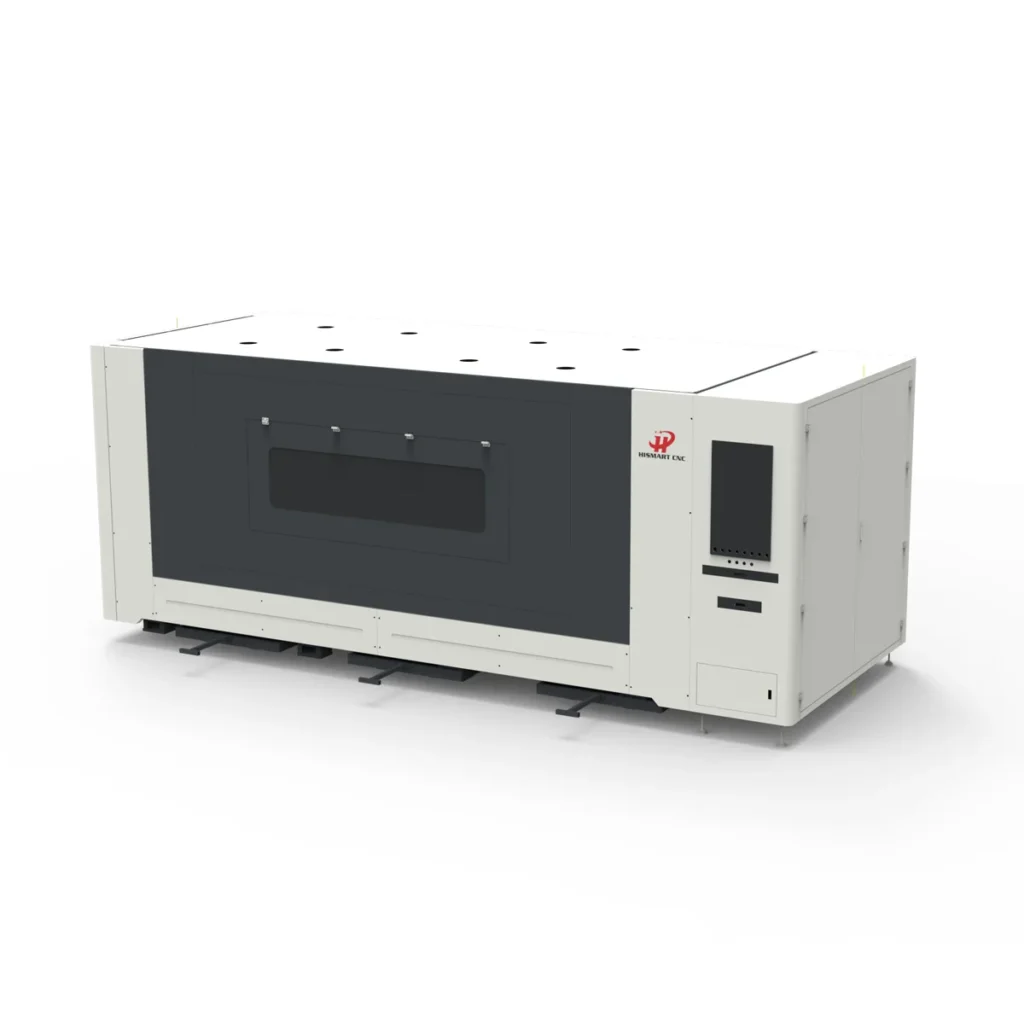
Hismart CNC HS3015i: A Practical Solution for Sheet Metal Cutting
At Hismart CNC, we provide fiber laser cutting solutions for metal fabrication businesses, manufacturers, and OEM/ODM customers around the world.
The HS3015i is designed as a single-table fiber laser cutting machine for sheet metal processing.
Its 3015-class working format is suitable for common sheet-metal applications, while the full-enclosed structure provides a more integrated machine design.
Depending on the selected configuration, Hismart CNC fiber laser cutting machines can be equipped with components from established industrial suppliers, including laser sources, servo motors, laser heads, and CNC control systems.
Hismart CNC’s current machine specifications include options such as YASKAWA servo motors, HIWIN/PMI linear guide rails, YYC racks and gears, MOTOVARIO reducers, and FSCUT control systems.
Hismart CNC also provides OEM/ODM services for fiber laser cutting machines, laser welding machines, tube laser cutting machines, and related CNC equipment.
How to Choose the Right Configuration
Before choosing a single-table or exchange-table laser cutter, ask yourself five questions:
1. How many sheets do you process every day?
If production volume is relatively low or moderate, a single-table machine may be sufficient.
2. How important is loading and unloading time?
If operators need to minimize every minute of downtime, an exchange table may provide greater productivity.
3. How much workshop space do you have?
Measure not only the machine footprint but also the space required for material loading, finished parts, gas systems, extraction, and operator access.
4. What is your total equipment budget?
Do not spend your entire budget on the machine itself. Consider electricity, compressed air or assist gas, fume extraction, consumables, installation, maintenance, and spare parts.
5. What will your production look like in three to five years?
A machine should match your current needs while leaving reasonable room for business growth.
Final Thoughts
There is no universally better choice between a single-table and exchange-table fiber laser cutting machine.
The right machine depends on your production volume, workflow, workshop space, investment budget, and future growth plans.
For high-volume manufacturers where loading and unloading time has a major impact on productivity, an exchange-table machine can be an excellent choice.
For small and medium-sized fabrication businesses that want reliable metal cutting performance without unnecessary complexity, a full-enclosed single-table fiber laser cutting machine can offer an excellent balance of performance and value.
If you are looking for a fiber laser cutting machine for your business, Hismart CNC can help you select the appropriate machine configuration, laser power, working area, and components based on your actual materials and production requirements.
Contact Hismart CNC for a customized fiber laser cutting machine solution and quotation.